
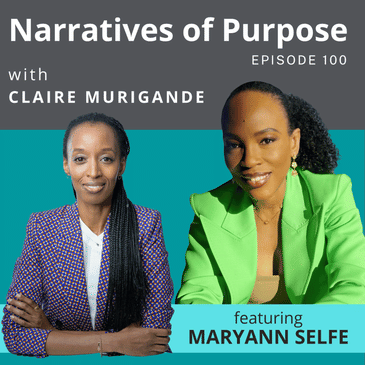
Why Women's Health Is the Investment Opportunity Investors Are Missing.
In the third episode of Narratives of Purpose's special series from the 2026 HIMSS European Health Conference, host Claire Murigande sits down with investment strategist Maryann Selfe, Founder of The Billion Dollar Blindspot.
With 25 years in institutional capital markets, Maryann brings a rare financial lens to a sector long underserved by research and funding. She shares how data gaps created by the systematic exclusion of women from clinical trials have distorted investment models — and why that's finally starting to change.
The discussion digs into the forces now converging to make women's health a compelling investment thesis: a massive demographic shift, the great wealth transfer, cultural change, and post-COVID technology breakthroughs. Maryann also introduces her platform, The Billion Dollar Blindspot, and her book of the same name — a practical guide for investors ready to enter the space.
Show Notes
LINKS:
Connect with Maryann Self on LINKEDIN
Learn more about The Billion Dollar Blindspot platform at billiondollarblindspot.com
Find all the details about Maryann's book at billiondollarblindspot.com/the-book
Follow us: LinkedIn
Connect with us: narrativespodcast@gmail.com | subscribe to our news
Tell us what you think: write a review
CHAPTERS:
00:19 - Introducing the HIMSS Europe 2026 Special Series and the Women's Health panel
02:27 - Maryann Selfe’s Journey From Banking to Discovering Untapped Opportunities in Women's Health Investing
06:25 - The Billion Dollar Blindspot: the Capital Intelligence Platform Breaking Down Healthcare and Women's Health
08:37 - Challenges in Investing in Women's Health and Why Invest Now
10:50 - The Billion Dollar Blindspot: Why Did Maryann Write the Book? And What Does it Cover?
Narratives of Purpose is a proud member of the SwissCast Podcast Network. Discover more great podcasts for English-speaking Switzerland: SwissCast Network.
Episode Transcript
Claire Murigande 0:03
Hello, dear listeners. Welcome back to Narratives of Purpose, the podcast amplifying social impact with me, Claire Murigande. I bring you conversations with global changemakers who are contributing to make a positive impact in society, with a special focus on healthcare innovation.
This is the third episode of our HIMSS Europe 2026 special series. After last year's event in Paris, I am back at the HIMSS, the Healthcare Information and Management Systems Society European Conference. This time in Copenhagen, gathering unique insights from some of the conference speakers.
My guest today is Maryann Selfe, founder of The Billion Dollar Blindspot, and author of the book of the same name. Maryann talks about the platform she created, how she got into women's health from a financial lens, and she explains why women's health is a smart investment opportunity of our time, hiding in plain sight.
Enjoy the conversation, share the episode with someone in your network, and remember that you can leave a comment on the Narratives of Purpose website using this short link bit.ly/narrativesofpurpose. Then select the review page.
Claire Murigande 1:18
Maryann Selfe, welcome to Narratives of Purpose.
Maryann Selfe 1:20
Thank you. It's great to be here.
Claire Murigande 1:21
And welcome to Copenhagen. We are here at the HIMSS, and this morning we were together on stage. We had a panel discussion at the Women's Health session.
Maryann Selfe 1:31
Yes, very engaging, and I think you did a brilliant job just managing the conversation. We could have talked for hours.
Claire Murigande 1:37
Thank you so much, and I'm really glad that they invited you because you know when we're preparing these sessions, they were looking for people who are active in women's health. But we wanted to take a different lens this time.
Last year, we talked a lot about obviously there are gaps and barriers, but the things that are missing in research and so on. But now we wanted to take it a bit further because you know down the line, what is actually missing is putting the money where it needs to be. And you have absolutely no background in health or science, rather in banking. And this is, I think, why it was interesting to have this panel: is to have this perspective, understand where do investors stand, how do we design these systems in terms of supporting companies and startups. Where are the bottlenecks today, and why is it that women's health is struggling, whereas it shouldn't?
So, before we go into all these details, please first introduce yourself for our listeners. One thing I can say that we're both based in Switzerland.
Maryann Selfe 2:33
That's right.
Claire Murigande 2:34
But beyond that, what should they know about Maryann Selfe ?
Maryann Selfe 2:37
Let's see. So, I am an investment strategist. I'm based in Switzerland, as you rightly say, and I've been in banking 25 years in institutional capital markets, and a lot of that experience has been in senior roles at Credit Suisse, later UBS, where I was responsible for investment advisory. I had responsibility for a desk of $5 billion in client mandates, and I had personal responsibility myself of managing $700 million of assets on behalf of private wealth. So this is my background, and this is where I come from.
Obviously, in private wealth, my mandate was global. So the one thread that has run through my career has been looking for the right investment solutions for my clients, whether those are institutional clients or private clients, individuals, and I think that's the thread that has run through my career.
In an institutional setting, my mandate was global. I look globally for the investment solutions, and I look across all asset classes. And I think my fascination with healthcare started about five years ago when I realized the gaps in the healthcare system as a whole, just in terms of the efficiency gains that we can have given the rise of AI and digital technologies.
And then when I looked deeper in the healthcare system, I just saw the gaps in women's health, and to me, those represented opportunities. And I thought to myself, "Well, why is no one talking to me about this?” And so, the more I looked, I just found this well of really investment opportunities.
Maryann Selfe 4:15
And I think that, you know, if we look at women's health today versus five years ago, I think maybe we could say five years ago, 10 years ago, it would have been a bit too early. But right now, we are at the point where there are several factors that are coming together. The time, really, to have an allocation or to have an exposure to women's health is really now.
And I started writing about it just because I wanted to talk to other people like me, asset allocators or capital allocators, who were responsible for deploying billions of dollars into investment themes to say “I think we should take a closer look at this” and that platform grew to what it is today, The Billion Dollar Blindspot platform, where we have think we reach about 20,000 readers in 110 countries, readers from all over the world in different walks of life, healthcare operators, venture capitalists, private equity general partners, curious readers, and people who are curious about the opportunities in healthcare.
And I think one thing that consistently came out of the interactions I was having were people saying to me, "I understand the investment thesis. When I write about all of the factors that mean that now is a great time to get exposure to women's health, people will write to me and say, "I understand what you're saying, and I truly see the opportunity as well. How do I invest? Where do I start?”
Healthcare is it's complex, and some of the opportunities, investment opportunities, mean going into the science, understanding the science, understanding the clinicals, the commercial opportunity. How do I do this? And that's what led me to write the book, The Billion Dollar Blindspot, which is out on the 26th of May, to really take potential investors through the opportunities themselves, you know, to talk about first of all, how did we get here that we have all of these opportunities? Why now? Why not next year or the next five or 10 years? Why now? And once you understand that, fundamentally how to engage with the sector? So I lay out a framework for how to engage in the stuff.
Claire Murigande 6:25
So before we break that down a bit, tell us about The Billion Dollar Blindspot platform. What is it exactly? You said you're reaching how many readers?
Maryann Selfe 6:32
20,000.
Claire Murigande 6:33
20,000. So what can they read there? We'll talk about the book, but what else do you have that is available?
Maryann Selfe 6:39
So the platform is first and foremost, it's a capital intelligence platform. So every week we break down what is happening in the world of healthcare and women's health. Unlike just reporting the news, we actually look at the deals that are happening, whether they're funding stories or breakthroughs in terms of regulatory approvals. We take what's happened and we look at it from an investor lens, and we break down what that means for investors.
For example, last week we wrote about a company called Candid Therapeutics and the acquisition of Candid Therapeutics by UCB. UCB is a large Belgian pharma company, and they have acquired this small company, which has basically come up with a protocol which tackles autoimmune disease. If you looked at the news, the press release that accompanied that acquisition, you know, UCB talked about the platform. They talked about the technology that they're acquiring, and they paid $2.2 billion. So they broke down the payment, you know, what that encompassed. But I think one thing that wasn't mentioned at all is the fact that autoimmune disease is a condition that disproportionately affects women.
And so we basically take that. We translate what that means for investors, what that means for women's health as a sector, and importantly for companies who are building or developing solutions in this space. What are some of the metrics or KPIs they should think about hitting, which would make them interesting to a would-be acquirer like a UCB?
So that's what you can find on the platform. Really, capital intelligence that talks about what is happening right now, what does it mean from an investment point of view, and where should investors be looking to deploy capital? Because this is where the smart money is going. We have a newsletter, we have a podcast as well, which we use really for awareness to make people aware of the gaps, but also the opportunities.
Claire Murigande 8:37
I like that you mentioned that, and this is also something that was highlighted during the panel discussion, that basically it's an opportunity you can also gain as an investor.
Maryann Selfe 8:47
Absolutely.
Claire Murigande 8:48
Why is is it that people don't see it at this point, especially from the investors' perspective? This, you know, perspective of saying “yes, we are actually going to make money, maybe in the long term rather than in the short term, but still, this is really an opportunity”. And it's smart investment, as you say.
Maryann Selfe 9:06
Yes. No, I think there are a lot of factors, and we could spend all day to talk about this. But I think the first thing is really that as an investor, we do have models and we do have a framework for evaluating an investment. Ultimately, for an investor, the risk reward has to make sense in order for you to make that investment. And unfortunately, I think the reality of the situation is that when we exclude women from clinical trials, as we did systematically until 1993, we don't just create data gaps; we create knowledge gaps.
That data and the knowledge gaps translate into incomplete models, incomplete scientific models, incomplete medical models, which ultimately translates into incomplete investment and advisory frameworks that we use to underwrite risk. So suddenly, because we don't have enough data to model on an opportunity that we're looking at looks a lot more risky. It doesn't fit the risk reward that we're used to seeing, not because it's more risky, but because we don't have the frameworks to model it accurately.
But I think that is changing now. It's slow, but it's moving in the right direction. I think now a lot of investors are recognizing. I think from the macro point of view, you know, we have in women's health a very large demographic tailwind. It's huge. We have the largest cohort of women coming into midlife, into premenopause menopause, and this has implications for not just women, but for families, for employers, for the society at large, and so there is the recognition from more investors that there is an opportunity here, which is completely untapped.
Claire Murigande 10:49
So that's a really clear explanation. And when you put it like that, it does make sense, right?
So tell me about your book that's coming out very soon, and why did you want to have this information in a book, because you said you have the platform already, what is the advantage of having all these thoughts in a book format?
And how does it position itself in this whole ecosystem? Because you say you have this perspective and you've seen the untapped potential in the market. What is this book going to bring in terms of awareness for the investors.
Maryann Selfe 11:23
No, it's a great question, and I struggled with it a lot myself. I mean, it's taken me several years to write the book, but one of the things I found was it was really a demand, a pull, because the subscribers that we have on our platform, the 20,000 odd people who read our newsletter every week-they come from all walks of life. Some people know are very familiar with the history, the data gaps, and so on. And so they come to women's health from a different point of view. Some people are completely-they've never heard of the fact that medicine was built, you know, using male biological baselines, they have never. It's the first time they're coming in contact with that, and so with the newsletter, it's on a weekly basis, and we write topical things.
So, if you're new to the topic, where do you start? How do you get a grounding that puts you at the same level as someone else, so that you have the confidence and the clarity to be able to make an investment decision, and that's why I thought, okay, put it in a book so that we have the full story, if you like, in one place.
And the book really starts by going into sort of the historical, you know, how did we actually get here? And so, for a complete newbie or a complete beginner to the topic, you can immediately understand why this data gap exists. And then, once we kind of go through that in the book, I use a lot of stories because the book was written after lots of interviews with founders, operators, investors, strategists, all working in women's health. So we have lots of real life stories, which really bring it to life. We start with the historical, just to kind of give a context and land at the same starting point.
And then from there, I turn the lens to what's happening right now. How do we see things? You know, what are the forces that mean that now is a good time, not five years ago or not five years in the future? So I talk about the sort of the forces converging. I kind of feel like it's a it's a convergence point. You know, we have the great wealth transfer, which is ongoing at the moment. More money coming into the hands of women. I think for the first time in living history, we have the capital, the people with the lived experiences of gaps and decision-making power converging in the same hands. That's fantastic. We've never had that before.
And then when you layer on the demographic tailwind that we have, the fact that now versus 30 years ago, we now have women spending more than a third of their lives post menopause. So that's a huge demographic tailwind that we see behind us. And of course, the change in culture. I mean, 30 years ago, women were not speaking publicly about menopause.
Claire Murigande 14:18
Exactly.
Maryann Selfe 14:18
It's happening today.
Claire Murigande 14:19
Yeah.
Maryann Selfe 14:20
And so I think also part of the problem for investors is, investors invest. One of the things you look at is is there demand for the solution? Because if there is demand, then you will have the market. If there's no demand, you're not going to have a market. And as long as women's pain was considered personal or private, it was very difficult for investors to model demand because no one is talking about this, so this is not a problem.
But today, more and more women are coming out and saying, "I am going through menopause. I need solutions. And so, for the first time, if you go on Reddit, you find a whole host of women complaining about all sorts of things, and this is fantastic. Because this change in culture means investors can now begin to see demand, and of course the changes in technology. I mean, COVID helped us massively because now with technology we can deploy solutions for women at scale at unit economics that are viable and profitable.
So I think with all of these factors coming together, and I go into a lot more detail about it in the book, it really demonstrates the why now for the investment thesis.
And then, of course, I wanted to address the question I get almost every week: How do I invest? What do I look for? What are some red flags? And we cover that as well in the book.
Claire Murigande 15:47
As you heard in our conversation, Maryann's book, The Billion Dollar Blindspot was published on the 26th of May, 2026. You can find all the information about it and learn more about why women's health is one of the most overlooked investment opportunities of our time on The Billion Dollar Blindspot platform at billiondollarblindspot.com. The link is in the show notes.
Thanks a lot for tuning in today. Join me again next week for a new episode featuring Marc Ritter, the CEO and co-founder of AWE Digital Wellness. Until then, take care of yourselves, stay well, and stay inspired.