Beyond the Proof-Of-Concept: How HealthSeed Is Scaling Healthcare Innovation Across Borders.
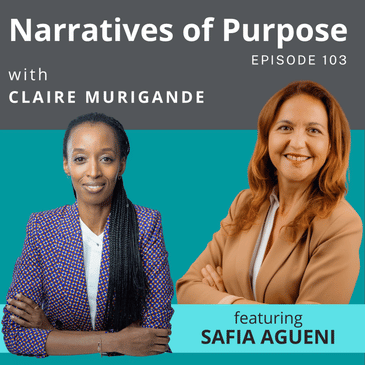
In the final episode of Narratives of Purpose's special series from the 2026 HIMSS European Health Conference, host Claire Murigande speaks with Safia Agueni, the COO and co-founder of HealthSeed.
HealthSeed is a Swiss healthcare venture studio helping biotech, medtech, diagnostics, AI drug discovery, and digital-health companies launch and scale across Europe, North America, and MENA.
In this interview, Safia shares her journey from nearly two decades in Big Pharma to launching HealthSeed, and why so many European health startups end up leaving the continent. She also discusses bridging innovation ecosystems across Europe, the Middle East, and Africa, and the power of community and trusted networks in building impactful ventures.
A must-listen for health tech entrepreneurs, impact investors, and anyone curious about what it really takes to bring healthcare innovation to patients worldwide.
Show Notes
LINKS:
Connect with Safia Agueni on LINKEDIN
Learn more about HealthSeed at healhseed.vc
Follow HealthSeed on social media: LinkedIn
Listen to all our HIMSS26 Europe episodes at bit.ly/himsseu26
Follow us: LinkedIn
Connect with us: narrativespodcast@gmail.com | subscribe to our news
Tell us what you think: write a review
CHAPTERS:
00:19 - Introducing the HIMSS Europe 2026 Special Series
01:35 - Safia Agueni's background and why she co-founded HealthSeed
04:50 - HealthSeed's three pillars, their target and focus
07:08 - The European startup exodus
10:15 - How HealthSeed supports companies
12:10 - Regional nuances: scaling in Africa and the Middle East
15:52 - HealthSeed's unique value proposition
17:57 - The HIMSS 2026 InnovationXchange
20:30 - The power of community and network to drive business
22:26 - Safia's advice for aspiring purpose-driven entrepreneurs
Narratives of Purpose is a proud member of the SwissCast Podcast Network. Discover more great podcasts for English-speaking Switzerland: SwissCast Network.
Episode Transcript
Claire Murigande: [00:00:03]
Hello, dear listeners. Welcome back to Narratives of Purpose, the podcast amplifying social impact with me, Claire Morigande. I bring you conversations with global change makers who are contributing to make a positive impact in society, with a special focus on healthcare innovation. This is the sixth and the final episode of our HIMSS Europe twenty-twenty six special series.
After last year's event in Paris, I am back at the HIMSS, the Healthcare Information and Management System Society European Conference, this time in Copenhagen, gathering unique insights from some of the conference speakers. My guest today is Safia Agueni, the co-founder and COO of HealthSeed Ventures Studio, a Swiss-based company that helps promising healthcare innovations scale successfully around the world.
Safia talks about bridging innovation ecosystems across Europe, the Middle East, and Africa, but also the power of community and trusted networks in building impactful ventures. Enjoy the conversation. Share this episode with someone in your network, and remember that you can leave a comment on the Narratives of Purpose website using this short link, bit.ly/narrativesofpurpose, then select the Review page.
Claire Murigande: [00:01:21]
Welcome, Safia, to Narratives of Purpose. Thank you for joining me, and thank you for connecting after the event because we met at HIMSS in Copenhagen, but unfortunately we were not able to record the podcast, and now we are connecting virtually. So tell our listeners who you are, a bit of your background very briefly, and especially I'm interested to, uh, understand and find out why you created HealthSeed, which is your company.
Safia Agueni: [00:01:48]
Thank you, Claire. Thanks for having me. I'm very happy that we made it for, you know, this recording after having met at HIMSS. So Couple of words about myself before, and I'll mention then, uh, why HealthSeed. So I've worked my entire career, mo- most of my time, in healthcare industry, in the big corporate. I started in Paris.
I'm French. I've worked in, uh, Novartis French affiliate before I joined Switzerland, Swiss ecosystem, uh, and joined Novartis headquarter, and I stayed 15 years in Novartis. Having worked in many different jobs around the healthcare business, I thought after leaving Novartis that I would start actually doing something else than corporate world, and I ended up, uh, going back to corporate because Roche made a, a very interesting offer to me, less on a financial perspective, but more on a challenge.
I got the opportunity to work in the field of personalized medicine. Roche was driving quite a lot in terms of this agenda very early on, and I got exposed to this, uh, field, which is, uh, passionating because it is actually the intersection between technology and life science, and really, you know, at the various early stage of AI and the possibility of AI in life sciences.
So I learned a lot. I also learned the challenges to really leverage this technology in healthcare, and also that it's much beyond technology and science when it comes to innovation, that actually it is about connection, ecosystem, adoption. And I learned it really the hard way because even as a big corporate like Roche, it is difficult to really innovate in the field.
So after having worked 15 years, I would say almost, uh, no, it's actually 19 years. 19 years, I cannot even believe it's almost 20 years in healthcare industry. It was more than the time for me to think of, "Okay, now what's next?" And what made me jump actually to the entrepreneur journey was the meeting I had in this cafeteria in Roche.
I met my colleague and now my CEO and co-founder of HealthSeed, uh, Darren Wilson. He shared the vision he had in mind, and it was actually extremely resonating with what I had in mind, which was, okay, we come across so many of those innovation which are promising and which are much needed for patient, but somehow they're stuck.
They're not scaling further. They do a lot of POC, you know, the e- eternal POC, right? The never-ending POC stage and prototype pilots. Many innovation receive grants, but then they're stuck, and We thought about how can we enable those innovation to scale successfully and even more to reach patient, not just in one market, but around the world where it's actually sometimes even more needed.
So this is why we founded HealthSeed. It's a venture studio based in Switzerland, but working globally with all regions, and our purpose is to spot really the most promising innovation, to really help those innovation to scale successfully because as I mentioned before, it's much more than science and innovation.
So it's equip those innovation with the right go-to-market strategy, the right partnership, and really help those innovation to scale in different markets. And also really, uh, venture building as well, pure venture building on promising moonshot. We come across some really promising innovation, which we could call a moonshot, and then we do proper venture building, and then ecosystem building as well.
So those are really the three main pillars about HealthSeed.
Claire Murigande: [00:05:42]
And just for clarification, in case listeners don't know, POC, proof of concept, correct?
Safia Agueni: [00:05:46]
Yes.
Claire Murigande: [00:05:48]
Perfect. So basically, you're helping startups or promising initiatives go beyond the, yeah, the initial phase and really become actual products in the market, right?
Safia Agueni: [00:05:58]
Yes. Have impact, exactly.
Claire Murigande: [00:06:00]
What type of, um, innovation or startups are you looking at? Are we talking health tech, digital health? Are you open, or do you have really specific area you're looking at?
Safia Agueni: [00:06:10]
Oh, that's an excellent question. So we have a target. So ideally, first of all, in terms of holistic approach, we want to push as much as possible preventative healthcare.
So it is a lot about med tech, digital health- Uh, we also do biotech, a lot of, uh, diagnosis. We are on purpose trying to push towards this direction because this is the area where we have a lot of preventative, uh, healthcare solution. And in terms of focus, I would say we don't work with very early stage, uh, company.
We work with the ones which have initial traction. They typically had a couple of grants and, you know, the, some of those fundings. They managed to reach traction, sometimes even early revenue, but they're like, "Okay, now what's next? How can we actually go and penetrate different markets? Or do we go to US?
Do we go to Asia?" And I'm not gonna tell you something new, most of the time the startups are not staying in Europe, which is also a big frustration for us, which is a focus for HealthSeed to try to keep promising European startup also in Europe.
Claire Murigande: [00:07:20]
That's interesting that you mention that. Is there a specific reason or specific reasons that most of these, uh, startups don't remain in Europe and develop outside of Europe?
Safia Agueni: [00:07:31]
Yes, there are a couple of factors indeed, and this was very well discussed and raised in Copenhagen when, uh, we attended HIMSS, but also at LS-X because it was a life science week in Copenhagen, uh, that time. And there was an, a brilliant panel tackling this innovation, which is really leaving Europe at some point, despite maybe existing mechanism, infrastructure or funding.
So reasons are, of course, let's face it, US is one market and is a large one So when you target US, you know that from an ROI and return on investment, I'll try to avoid acronyms now . Um, in terms of return on investment for your investors, it is actually extremely compelling. So that's one reason that you go to US, and this is a big market.
Instead of doing Europe, which each country is a different market, and from a regulatory perspective, from reimbursement pathway-
Claire Murigande: [00:08:29]
Yes ...
Safia Agueni: [00:08:30]
partnership, right? Every market is like, okay, how we're gonna figure out? This is France, this is Germany. So it is really a headache for a company, a bigger risk. The second one, I would say for capital, we see it and from numbers, uh, we can really look for the data points there.
They are definitely available. When you start to look at a certain fundraise, let's say you raise not just two, three millions, but you start to raise more, 10, 15, even more, you know, for biotech it's even more, you struggle to raise in Europe. And investors are, uh, most of the time, they're very conservative.
They're not looking at those long-term investments. They wanna see return on investment much earlier, and in healthcare it's very difficult. So those are some of the reasons, I think, and that's why we actually as Health Seed, we launched the initiative called Health Scale. It's a bit separate from our activity, and it's, uh, something we do within a nonprofit setting, and it's actually about tackling those challenges around scaling innovation in Europe because we believe we need to Connect the different ecosystem player.
And when I say ecosystem, it's corporate, startup, incubators, university, hospital, everything which is, uh, needed to work together to really equip and have the right infrastructure, including policy, to enable those, uh, startups to innovate and scale in Europe.
Claire Murigande: [00:10:03]
What you described is different from your other activities, but what are actually your other activities?
Can you give us like an overview of how you would support, I don't know, a biotech, for example?
Safia Agueni: [00:10:15]
Typically, we support company with their initial strategy, revising their strategy on how they look at their go-to market. They come to us, they think they figure out everything, every details. They know exactly who they want to work with.
They're like, "Help us to maybe work with Roche or Novartis or another big pharma." But actually, when you scratch a bit the surface, you have to first reposition a little bit their storyline or their strategy sometimes, their timelines, their roadmap, which partnership they foresee. So we do a bit of strategy work there.
And sometimes, of course, they come and they need to fundraise. They're looking for capital. Many startups do. We don't do that, uh, mainly because there are lots of organization acting a bit as intermediate broker. We are not interested in that. The reason is, for us, the big focus is first Know inside out a company, believe in this company and what they're driving and the innovation, and if we do believe in that, we wanna support them end to end.
So we wanna support them on the strategy. We set them for success, and then we believe, okay, this is really, for us, a, a success story, promising success story. So we are ready to then make introduction, warm introduction for them to investors. So we do support fundraise as well, and then we help them on different milestone because every stage is different challenge, different milestone.
Let's say run a clinical trial or develop a partnership with a specific region. Uh, as you know, I'm very much involved in Middle East, North Africa region in particular, and it's different codes, right? Different ways of collaborating with this region, so it could be another milestone for them at some point, and then we help them.
So very much milestone outcome driven based collaboration with startups.
Claire Murigande: [00:12:10]
Good point that you mentioned Middle East, North Africa, because that's the other question I wanted to ask you. I was looking at your website. So Health Seed is based in, uh, Switzerland, so it's Swiss-based with a global impact. And you already mentioned the US, so you also work with North America, Middle East, North Africa.
Tell me about the differences or, say, the uniquenesses of these regions and perhaps also some similarities. What do you see from your perspective based in Europe? How can you describe that?
Safia Agueni: [00:12:38]
First of all, I mean, Africa for me is a bit special because I'm native from Africa, so I'm from, uh, Algeria originally, and I've been observing Africa rising somehow and impressed by the talents there, but also the innovation.
And the big difference, I would say, for such a continent, it is about life-saving sometimes when they really push innovation. It's life-saving, and there are lots of remote places. When you look at Europe, we are already struggling to access healthcare professional or do an exam, but in Africa, in some places, it's even worse.
It's like it's, it's impossible. So you must innovate, and that creates this resilience for those talented people and super skill, the resilience to really innovate with sometimes very little fund, so this is impressive. So for me, one of the big opportunity and strength of such a continent is the potential of scaling with not much money They do a lot, and this is what I'm impressed, and the impact, because at the end of the day, it's about the impact you can have on patients.
So that is a narrative that I realize it's attractive for now more and more smart capital and family office. So investors are looking more just beyond just return on investment. It's like, how can I make an impact? And we are capable of showing them a narrative there to say, "Look, you're gonna have a return on investment, but you're also gonna have this amount of impact," and that is very much attractive.
So for me, that's one aspect. The other with Middle East is, um, it's often we hear, okay, you go to Middle East, there's a lot of capital there, but they come with their innovation, and they think it's ready to implement. But they are completely missing the whole point that first the culture is completely different.
What they developed might not fit at all in such a setting. Plus, Middle East has nailed down a couple of their priority with the 2030 vision, and they wanna focus on very specific area, and they're looking for innovation that have already proven that they're working, not just prototype. So they're very selective in the innovation.
But once they spot the right innovation, they're extremely open to collaborate, not just plug and play, but like really Build this with us, co-create, co-build something with us, and eventually then we will scale together to impact really the region, right? So this is really for me why I focus a lot on this region, to create bridges with Europe and Switzerland in particular.
Of course, we have a, a very interesting and compelling environment and innovation, uh, ecosystem in Switzerland, so pretty attractive. But really connecting those and translating this into a win-win partnership is what makes it, for me, very interesting.
Claire Murigande: [00:15:38]
Would you say that this is your unique proposition as HealthSeed, or do you have also other companies similar to you doing this work, like bridging, you know, continents and cultures, changing that narrative, so to speak?
Safia Agueni: [00:15:52]
So before launching, we actually did our homework, and we look into what is already available. So there are many organizations supporting startups, but what's probably unique for us is, first of all, we are not supporting startup in a given environment. We are supporting startup and opening doors across different region, and that's pretty unique, right?
Second, I would say we are operators. We are not just generic, I would say, consulting with strategy. We are also doing the work and co-building with the startups. Why? Because we did it ourself. My CEO has made different launches in big markets. We've also worked at an open innovation program when we were at Roche and Novartis.
And we have, of course, all the networks, and we know inside out how we work in the corporate environment and how we could foresee open innovation with those, uh, startups. So that's probably a uniqueness. And we are driven also by impact, so connecting the right ecosystem player to really make the biggest impact for patient at the end.
So probably a uniqueness. And another one is we work across a network of partners, and we call them strategic partners. I think for me, this is gonna be a model more and more coming with what's happening now and how AI is disrupting the whole job market. We work with people who want to really stay Free in terms of their engagement and how they work.
They're driven by, uh, impact more than anything else, and our narrative is pretty compelling and attractive to them, so they are really joining us as strategic partner, and it's kind of one plus one equals more than two, right? It equals three or four. So really creating this sense of belonging, the community thing, is probably also something very special, which I'm extremely passionate, as you know, with the community building.
Claire Murigande: [00:17:46]
Yeah, and it really comes out as you speak. And I'm not sure we'll have time for this, but speaking about community, I know that you work with women in tech, right?
Safia Agueni: [00:17:54]
Yes.
Claire Murigande: [00:17:54]
You created the Swiss chapter.
Safia Agueni: [00:17:56]
Yes. Absolutely.
Claire Murigande: [00:17:57]
But I'd like to come back to HIMSS.
Safia Agueni: [00:17:59]
Yes.
Claire Murigande: [00:18:00]
And one of the session you're a part of is the Innovation Exchange.
Can you describe exactly what that was and how the organization or the conference at that point is supporting, uh, startups? Because last year what happened is they did a pitch competition, so I think the classical pitch where, you know, people came in, presented their startup, and then there was a winner.
But this time was completely different, so can you describe that a bit?
Safia Agueni: [00:18:24]
Of course. You're absolutely right. The first time I was proposed to join this challenge- I was like, "Oh, that's interesting." We are actually the ones put on spot as investors or as partners, ecosystem partners. But I think now that I experienced that, I really enjoy it.
I think they tested it for the first time to see if it works. We were given, uh, very specific challenges that the startup is facing, and we were the one who had to basically pitch the solution to the challenge that the startup, uh, came with. Um-
Claire Murigande: [00:18:58]
Oh, wow. Yeah. So it was the other way around.
Safia Agueni: [00:19:00]
Exactly. And I was like, "Oh, that puts really the burden on us, now we have to work."
But it was extremely interesting, really. So for me, I had few of the startups and it was a way to engage in more conversation on two direction. Instead of this typical one, okay, I'm the startup, I get, let's say, two minutes to do my pitch, and they do it, and usually in a very systematic way. And it's less of interest.
I would say this time with this setup, it was allowing more this conversation after bringing sometimes follow-up questions from our side and a initial perspective that we were sharing. Not saying we provide, of course, the final solution, because who has a final solution in two minutes? But it's like a nugget somehow.
So we were putting couple of nuggets, and then we started to have this conversation and question on two direction, and it was ending up being a meaningful conversation. And of course, also a very interesting follow-ups then with the startups. So I really enjoyed the experience actually myself.
Claire Murigande: [00:20:02]
Is it something that you would do again?
Safia Agueni: [00:20:04]
Absolutely, 100%. I would actually recommend. I think I provided feedback to the organizers that, uh, that's something I would definitely recommend to reiterate next time.
Claire Murigande: [00:20:13]
Another question about the HIMSS conference. It was the first time you attended, or have you been there before?
Safia Agueni: [00:20:18]
That was my first time.
Claire Murigande: [00:20:19]
Okay.
Safia Agueni: [00:20:19]
'Cause I know the conference really well, but it was my first time. I probably didn't have the opportunity to attend before. And now it was my first time, and it's probably not gonna be the last time.
Claire Murigande: [00:20:30]
Yeah, because that's one thing I found very interesting about HIMSS. For me, it was my second time.
It's very also community-driven, and I think it's quite similar to what you're doing as well, you know, with your venture studio- Yes ... and all the other activities. And my question to you is: how do you see, like today in the age of tech and AI, how do you see the, the strength of community, or I would say the strength of building from the grassroots, right?
How do you see that influencing or taking advantage or even leveraging tech in terms of- Reaching impact, but also scaling solutions that really matter.
Safia Agueni: [00:21:02]
I think it's one of the major differentiator nowadays, building on community, looking at connection. In the old times, I think we were all already attending conferences, okay, and you come back, and then you're back to your work.
But now you actually do really the work through your network, through the community. It is becoming more and more the power that you can really leverage, and much more than what you think. I see now, for example, for HealthSeed, it's been a year that we incorporated, so not much, but we haven't done any outreach.
And why? Because we basically just leverage our network around us, our trusted partners that we've worked already in different opportunities, and just leveraging that, and also, of course, being present in some of those important e- events like HIMSS is what really matters because you start and you initiate those, uh, very critical conversation in those forums, and then you follow up.
And actually, funny enough, this morning we had a follow-up call with one of the health accelerators in, in Nordics country who was present at HIMSS, and we were following up, you know, for this collaboration because we sparked already some potential synergies. So for me, it's all about that now in the future, even more than what it used to be in the past.
Claire Murigande: [00:22:26]
What would you perhaps advise people who want to change and do something more impactful, meaningful, and they want to build something, just like you went on and create HealthSeed, you know? What would you advise them if that's what they want to do at this point while they listen to you?
Safia Agueni: [00:22:41]
I would say listen your gut feeling sometimes when it tells you, like, it's time to maybe turn things around and do something different, and leverage your wisdom.
Because at some point, people who have worked years in challenging jobs in corporate, they learn so much, they went through different challenges, and this is a wisdom that they can really leverage, and it has never been a better time than now with the technology, with AI, with all these capabilities to wrap this up a little bit, to frame it, to first identify, of course, what is the unmet need you wanna really solve, right?
Because it always starts with that, like a founder, like anything, any initiative. What are we trying to solve? Before any innovation, before starting to really code or something, what are we trying to solve? And if you're passionate about that, because it's all about passion as well, if you're ready to put passion, time, energy in something you wanna solve in this planet, then you have everything, you know, to really address it.
And if you put that effort, passion- You're gonna really be successful because you're gonna find really people and partners who are sharing the same vision and mission with you, and you can have an impact and eventually be successful as well while pursuing your goal.
Claire Murigande: [00:24:01]
Maybe playing a little bit devil's advocate on that.
Passion is great, and I think you can follow your purpose, but what has been for you the most challenging part in really taking that step but also making sure that you still continue to do what you do? Because now you're an entrepreneur. Before, you were in corporate. It's completely different, right? So what has been the most difficult challenge?
Safia Agueni: [00:24:24]
Of course, I'm glad you're mentioning that, Claire, because you're right. This is not an easy journey, and it's not for everyone. I hear you. You have to be prepared for that. You need to know this, of course, takes time. You need to build resilience. You need to believe that eventually it's gonna work, and not, like, just wanting to stop it the minute you face a door closing, right, a wall.
You have to build that resilience. But I think many people have already built that even in corporate setting because you go through so many reorg, you know. You build a bit of resilience during that. But then I think some of the challenges besides that it takes time, you have to first maybe do a bit quick wins.
Take baby steps. Agree to maybe compromise a little bit initially on the first steps you're gonna make before reaching really ultimately your goal. Do maybe a bit of work that you're not super passionate about but that's gonna pay your bills so that in the background you're gonna work on more the long-term project.
So that's of course a reality we need to tell people and not just sell, you know, the dream and everything, right?
Claire Murigande: [00:25:30]
Thank you so much. Thank you very much for taking the time, Safia. And maybe next time we can talk about women in tech, 'cause I think this is another thing you're very passionate about, and you've built an amazing community here in Switzerland, and you're part of a more global initiative.
Thank you so much for joining me.
Safia Agueni: [00:25:45]
Thanks for having me, Claire.
Claire Murigande: [00:25:51]
Learn more about Safia Aguenis' work and her team at HealthSeed on their website at healthseed.vc. The link is in the show notes. Thanks a lot for tuning in today. This was the final episode of our 2026 HIMSS Europe series. If you enjoyed this interview and the other conversations, please share in your network.
You can find all these episodes on a dedicated playlist at the following link, bit.ly/HIMSSEU26, or simply click the corresponding link in the show notes. Goodbye for now, and until the next episode, take care of yourselves, stay well, and as always, stay inspired.